Ask a Year 13 student why their chemistry grade is lower than they expected and you will usually hear the same answer. They found the content hard.
Look at the actual mark breakdown and a different picture tends to emerge.
The theory papers are often respectable. The marks are haemorrhaging somewhere else entirely, in the practical assessment, and specifically in how experiments are recorded, analysed and evaluated.
Why This Goes Unnoticed
Practical work feels like the easy part. Students enjoy it, they are active, and the immediate feedback in a laboratory is more satisfying than working through equilibrium calculations.
That enjoyment disguises the difficulty. Practical assessment is not testing whether a student can perform an experiment. It is testing whether they can think and write like a chemist under time pressure.
Those are different skills, and only one of them is practised regularly.
This is the gap that well-targeted A-Level Chemistry tutoring tends to close fastest, because the marks lost here are procedural rather than conceptual, and procedural problems respond quickly to focused work.
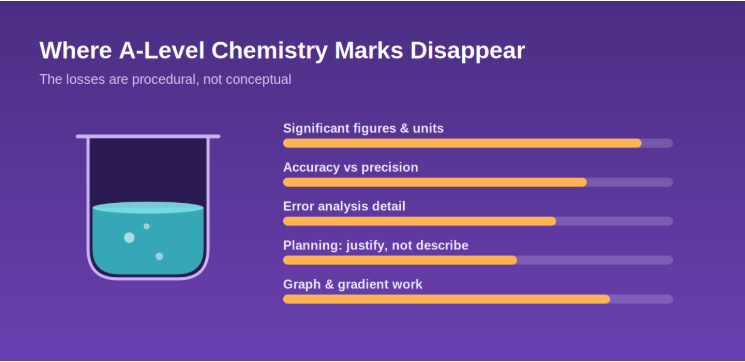
The Five Places Marks Disappear
1. Significant Figures and Units
This is the most avoidable loss in the entire subject.
A student performs a titration correctly, calculates the concentration correctly, and writes the answer to the wrong number of significant figures. The mark is gone.
The rule is not complicated. The answer should reflect the precision of the least precise measurement used. Students know this and forget it under pressure, every single time.
Units cost marks in the same way. A concentration without mol dm⁻³ attached is an incomplete answer, and mark schemes treat it as such.
2. Confusing Accuracy With Precision
Ask a student to evaluate their results and most will write something about human error.
This earns almost nothing, because it does not distinguish between the two things examiners are actually assessing.
Precision is about how closely repeated measurements agree with each other. Accuracy is about how close the result is to the true value.
A set of concordant titres that are all wrong is precise and inaccurate. A student who cannot articulate that distinction cannot access the higher evaluation marks, regardless of how well the experiment went.
3. Vague Error Analysis
Human error and the equipment was not accurate are the two most commonly written and least rewarded phrases in A-Level chemistry.
Mark schemes want specificity, and usually quantification.
A strong answer identifies which measurement carried the largest uncertainty, states the apparatus uncertainty as a percentage of the measured value, and explains the direction in which the result would be affected.
That is three sentences. It is also the difference between one mark and four.
4. Planning Answers That Describe Rather Than Justify
Planning questions ask a student to design a method. Most students describe what they would do.
The marks are in why.
Why that concentration. Why that volume. Why that indicator rather than another. Why control that particular variable.
A method without justification reads as a recipe, and mark schemes for planning questions are built almost entirely around justification.
5. Graph Work Treated as Decoration
Graphs carry more marks than students expect, and they are marked strictly.
Axes without labels or units lose marks immediately. Scales chosen so the plotted points occupy a quarter of the grid lose marks for poor use of the range. Lines of best fit drawn through every point rather than through the trend lose marks for misrepresenting the data.
Gradient calculations are where the largest losses occur. Students frequently read a gradient off two plotted points rather than two points on the drawn line, which is not the same thing and is marked as an error.
The triangle used to calculate the gradient should span at least half the drawn line. Small triangles amplify reading error, and mark schemes penalise them.
None of this is conceptually difficult. All of it is routinely lost.
How Much Time This Deserves
A reasonable question at this point is how much of a revision timetable should go on practical technique rather than content.
For a student already scoring reasonably on theory, considerably more than they are currently giving it, and the reason is arithmetic rather than pedagogy.
Practical assessment typically carries a substantial share of the total qualification. If a student is losing a third of the available marks in that component while performing well elsewhere, the practical marks are the largest single pool of recoverable grade in the subject.
Compare that with content revision. A student who already knows the material well might add a small number of marks by revising it again. The same hours spent on error analysis and planning justification typically yield considerably more.
The practical work is also more durable. Content knowledge fades between revision and examination. Technique, once internalised, does not.
Why Practical Skills Are Weighted the Way They Are
It can seem strange that a written examination places so much weight on laboratory technique.
The reasoning becomes clearer when you look at what the qualification is preparing students for. Chemistry is an experimental discipline, and the professional standards around data handling, uncertainty and reproducibility sit at the centre of it, something reflected in the educational resources published by the Royal Society of Chemistry.
A student who can recite reaction mechanisms but cannot evaluate the reliability of their own data has learned chemistry as a body of facts rather than as a method.
The practical papers exist to test the method.
What to Actually Do About It
The remedy is unusually concrete, which is why this is worth acting on.
Work through past practical papers with the mark scheme open beside you. Not afterwards, beside you. The objective is to learn what the examiner is rewarding, not to test yourself.
Write out full error analyses for experiments already completed, even old ones. The calculation practice transfers directly.
For every planning question attempted, add a justification sentence to each step, then check it against the mark scheme.
Build the habit of stating significant figures and units before the calculation, not after. Under examination pressure, anything left to the end gets dropped.
The Point Worth Taking Away
If a student is scoring well on theory and poorly overall, more content revision will not help. They already know the content.
The marks are sitting in a skill that looks minor, is taught briefly, and carries substantial weight.
It is also, fortunately, one of the fastest things in the entire A-Level to improve, because unlike understanding organic mechanisms, it is largely a matter of knowing what the mark scheme wants and giving it to them.