Why dirt-work defeats so many rural property owners
Across the rural United States, the long gravel driveway is almost a defining feature of country living. Through a hot, dry summer of ranch traffic and small-farm hauling, those surfaces wash, rut, and harden into a washboard that rattles every truck that crosses them.
The trouble is that loose grading by hand never reaches the compacted layer underneath, which is exactly why a box scraper has become the standard answer for driveway and dirt-work projects on small acreage.
Most people imagine leveling as a smoothing task, like spreading frosting. In reality, packed ground behaves more like a slab of brittle stone, and you cannot smooth what you cannot first break loose. Understanding that single distinction explains why one implement succeeds where a simple blade fails.
The implement is a steel box, and the geometry does the work
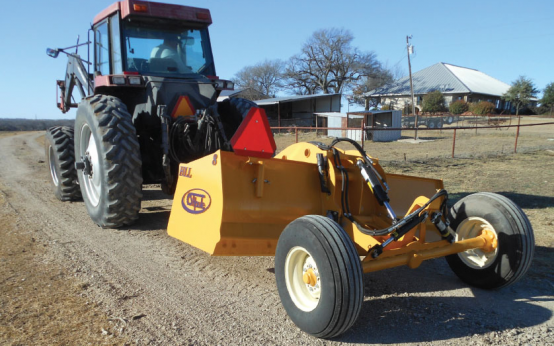
Strip away the marketing and the box scraper is exactly what its name says: a three-sided steel box, open at the bottom and at the back, mounted to a tractor through a three-point hitch.
The box is the container; the cutting edges are the knives; the shanks are the chisels. Each part has one job, and they act in sequence as the tractor pulls the frame forward. The genius of the design is that a single pass performs four distinct mechanical operations.
Those four operations are cut, carry, fill, and level. Once you can see each one happening, the behavior of the tool on real ground stops being mysterious and becomes predictable, which is the whole point of learning how it works.
Why the rippers fracture ground a blade cannot cut
Compacted soil and hardpan resist a flat blade because the blade tries to shear a wide, continuous ribbon all at once. The resistance across that full width is enormous, so the blade simply rides up and skips over the surface instead of biting in.
The ripper shanks solve this with concentrated force. Each shank is a narrow steel tooth, and because it contacts the ground over a tiny area, the downward pressure per square inch is very high.
A shank acts as that wedge and lever at once. It drives below the hard crust and pries upward, fracturing the compacted layer along natural lines of weakness rather than trying to slice straight through it. Five shanks working in parallel break a wide swath into loose, liftable material.
Capture, transport, and the art of fill
Once the rippers have shattered the hardpan, the leading cutting edge of the box shears off the loosened high spots, and the box itself captures that material. The three steel walls trap the soil so it travels with the implement instead of squirting out to the sides.
Now the operator has a mobile reservoir of graded material riding inside the frame. Carrying soil is the step that ordinary blades cannot manage, because a blade only pushes a wave of dirt ahead of itself and loses it at every dip in the ground.
When the box reaches a low spot, the captured material spills out the open back to fill the depression, while the rear cutting edge strikes off the surface to a smooth plane. High spots feed low spots automatically, and the ground tends toward level with each pass.
Reversible edges and the economics of wear
The cutting edges take constant abrasion from soil and gravel, so they are the part that wears out first. On a well-designed implement those edges are reversible and replaceable, bolted rather than welded in place.
When one side dulls, the operator unbolts the edge, flips it end for end, and presents a fresh sharp face to the ground. That single design choice roughly doubles the service life of the wear parts before any replacement is needed, which matters on a tool that sees seasonal heavy use.
Classifying grading tools by what they actually do
It helps to sort leveling implements by mechanism rather than appearance, because three common tools look similar but behave very differently. The differences come down to whether the tool carries material, self-references off its own frame, or merely pushes.
•Box scraper: rips, carries, fills and levels, relocates soil
•Land plane: long frame shaves peaks, finishes well but weak at digging
•Rear blade: pushes soil one way, simple but carries nothing
The trade-off is straightforward. A tool that carries material can build and reshape; a tool that self-references can finish smoothly; a tool that only pushes is cheap and flexible but demands the most skill for a level result. Reading the implements this way prevents a common mistake, which is expecting a finishing tool to dig or a digging tool to finish. The right pick follows from whether the job is breaking ground, relocating soil, or smoothing a surface that is already roughly shaped. Naming that job first saves time, fuel, and passes across the ground.
Sizing the box scraper to the tractor
Match matters as much as mechanism. A sixty-inch working width paired with five ripper shanks is sized for compact and subcompact tractors in the eighteen-to-thirty-five-horsepower range, the machines most common on hobby farms and small ranches.
That balance is deliberate. Too wide a box starves a small tractor of the power needed to drag a loaded frame uphill, while too narrow a tool wastes passes. The three-point hitch lets the operator regulate depth precisely, dropping the shanks deeper on stubborn ground and lifting them for a light finishing pass.
A working example from the field
Consider a small cattle operation in central Texas after a rainless summer. The quarter-mile entrance road has set up like concrete, with ruts deep enough to scrape a trailer hitch and a high crown that channels every storm into the wheel tracks.
On the first pass the operator drops the shanks to fracture the baked crust, then raises them and lets the box carry the loosened material forward. By the third pass the high crown has fed the low ruts, the rear edge has struck the surface flat, and a road that fought every vehicle now drains and rides clean.
For property owners facing that same cycle of summer ruts and compacted lanes, a box scraper turns several days of frustrating hand labor into an afternoon of confident, repeatable grading.
Understood as a sequence of cut, carry, fill, and level rather than a single magic motion, the implement stops being intimidating. It is simple physics applied with patience, and that is precisely why it has earned its place in so many rural toolsheds.