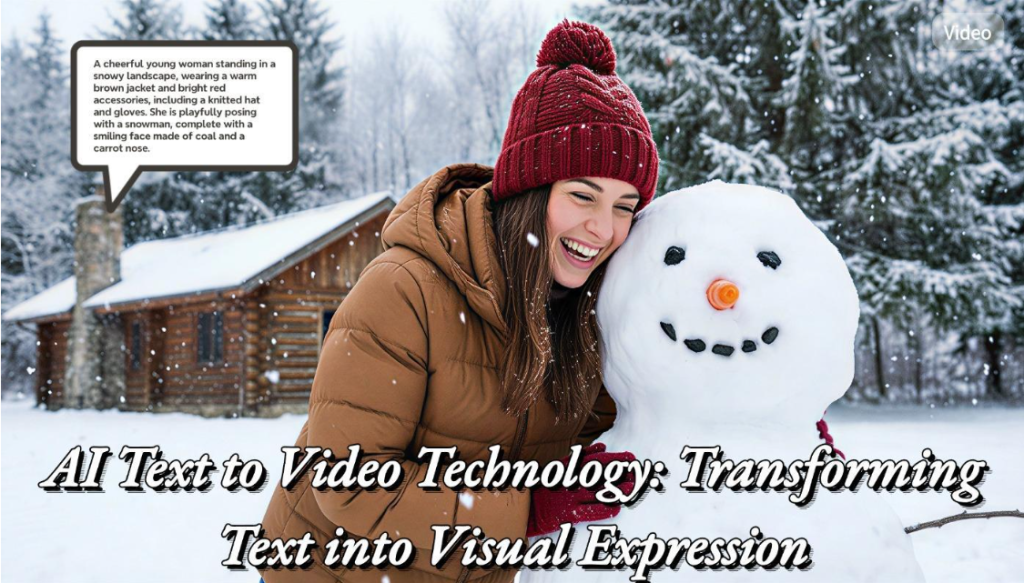
In the current digital landscape, video has transcended its status as a “bonus” marketing format. It has evolved into the fundamental language of the internet. The trend is validated by major industry benchmarks. In its comprehensive Annual Internet Report, networking leader Cisco projects that online video will create more than 82% of all consumer internet traffic. Corroborating this from a business perspective, Wyzowl’s latest “State of Video Marketing” report found that a record 91% of businesses use video as a marketing tool.
However, a significant dichotomy exists. While video is the preferred medium for information consumption, “speaking” this language has traditionally been resource-intensive. High-quality video production requires technical skills in filming, editing, lighting, and on-camera performance. This barrier has left many brands and professionals fluent in text but illiterate in video.
This is where Text to Video technology serves as a critical infrastructure upgrade. It is not merely an efficiency hack; it is a mechanism that translates written expertise into visual communication. By leveraging an AI Text to Video Tool, organizations can democratize video production, ensuring that video expression becomes a standard capability rather than a specialized luxury. This article analyzes the current landscape of these tools, their core technologies, and their strategic value in business applications.
From Script to Screen: How AI Text to Video Technology Works
To understand the strategic value of this technology, one must first understand its operational capabilities. Text to Video solutions are software platforms that utilize artificial intelligence to convert written input—scripts, blog posts, or articles refined with an AI humanizer—into professional-grade video content automatically.
Overview
The operational workflow of a standard AI Text to Video Tool typically follows a four-step process:
- Input Analysis: The user provides a script or a URL to an existing article.
- Semantic Understanding: The AI analyzes the text to understand context, keywords, and tone.
- Asset Synthesis: Based on the analysis, the engine either selects relevant stock footage from a vast library or generates new visual assets using generative AI models. It acts as an automated editor, matching visuals to the narrative arc.
- Audio Synchronization: The tool applies a synthetic, human-sounding voiceover (Text-to-Speech) and synchronizes it with the visuals and subtitles.
Advantages
The primary advantage of using these tools is the transition from “creation” to “curation.”
- Removal of Technical Barriers: These tools eliminate the need for cameras, microphones, or complex editing software (like Adobe Premiere Pro). Users do not need to appear on camera, solving the issue of “lens anxiety” for subject matter experts.
- Scalability: Traditional video production is linear and time-consuming. An AI Text to Video Tool allows teams to create AI videos from text in minutes rather than days, enabling mass production of content.
- Global Accessibility: Many platforms offer instant translation and localization, replacing the voiceover and subtitles to suit different geographic targets instantly.
Core Technologies
The efficacy of Text to Video platforms relies on the convergence of three distinct AI branches:
- Natural Language Processing (NLP): This allows the software to “read” the script, parse the syntax, and understand which visual concepts correlate with abstract ideas in the text.
- Generative AI & Computer Vision: While earlier tools relied on matching keywords to stock footage databases, modern tools utilize diffusion models (similar to those used in image generation) to create unique visual sequences frame by frame.
- Neural Text-to-Speech (TTS): Advanced neural networks now produce AI voiceovers that capture intonation, pacing, and emotional nuance, making the audio indistinguishable from human narration in many contexts.
Putting AI Video to Work: Proven Use Cases for Strategic Advantage
The theoretical capabilities of AI translate into measurable business outcomes. The following use cases illustrate how enterprises use these tools to create AI videos from text for strategic advantage.
Use Case 1: Corporate Learning and Development (L&D)
- The Challenge: Traditional employee onboarding often involves reading dense PDF manuals or clicking through static PowerPoint slides. This leads to low retention rates and “click-through fatigue.”
- The Application: L&D departments are using Text to Video technology to convert compliance documents and standard operating procedures (SOPs) into engaging instructional videos.
- The Result: By converting text-heavy policies into visual formats, companies report higher completion rates and better information retention. Furthermore, when policies change, the video can be updated simply by editing the text script, rather than re-reshooting a human instructor. This reduces content maintenance costs significantly.
Use Case 2: Content Marketing and Repurposing
- The Challenge: Brands invest heavily in high-value text assets like white papers and blog posts, only to see them underperform in the fast-scrolling, video-centric feeds of platforms like LinkedIn, TikTok, and Instagram.
- The Application: Marketing teams utilize an AI Text to Video Tool to automatically summarize long-form articles into 60-second “teaser” videos or explainer content.
- The Result: A specific case study involving a B2B SaaS company showed that embedding AI-generated summaries at the top of blog posts increased “Time on Page” by 150%. Additionally, the ability to create AI videos from text allowed the team to increase their social media posting frequency from twice a week to daily, resulting in a 40% increase in organic reach.
Use Case 3: Customer Support and Success
- The Challenge: High volumes of support tickets often stem from repetitive questions that are answered in the Help Center, which users find difficult to navigate or interpret.
- The Application: Support teams convert Frequently Asked Questions (FAQs) into a library of video tutorials.
- The Result: Video creates a “show, don’t tell” experience. Companies implementing video-based knowledge bases have observed a reduction in Tier-1 support tickets. A video explanation minimizes ambiguity, leading to higher Customer Satisfaction (CSAT) scores.

The Next Evolution: Future Trends in AI Text to Video
As we look toward the next 12 to 24 months, the Text to Video landscape is poised for significant disruption.
- Shift to Native Generation: The industry is moving away from stock-footage assembly toward fully generative models. Technologies similar to OpenAI’s Sora indicate a future where scripts generate entirely original, cinematic motion without relying on existing databases.
- Hyper-Personalization: We anticipate the rise of Real-Time Video Generation. In this scenario, an AI Text to Video Tool could generate a unique video for a specific user on the fly, referencing their name, specific data points, and needs—effectively allowing for 1-to-1 video marketing at scale.
- The “Prompt Engineering” of Video: The skill set for video creators will shift. The ability to write precise, descriptive, and logically flow prompts (Prompt Engineering) will become more valuable than the ability to operate a physical camera.
FAQ: Using AI Text to Video Tools
Q: Who is the ideal user for these tools?
A: These tools are ideal for content marketers, HR professionals, educators, and news publishers who need to scale video production but lack technical editing skills or budget for a production crew.
Q: Can I monetize videos created with AI?
A: Generally, yes. Most paid subscriptions to an AI Text to Video Tool include commercial rights for the assets generated. However, it is crucial to review the Terms of Service of the specific platform, especially regarding music licensing.
Q: How steep is the learning curve?
A: The learning curve is minimal. If you can write a document, you can use these tools. Most platforms are designed with a “drag-and-drop” interface that simplifies the process to create AI videos from text.
Conclusion
The transition of video from a high-budget marketing tactic to a fundamental form of communication is complete. In a digital environment where attention spans are shortening and visual preference is rising, the ability to articulate ideas through video is no longer optional—it is a baseline requirement for brand relevance.
Text to Video technology bridges the gap between the need for video and the capacity to produce it. By adopting a robust AI Text to Video Tool, businesses can unlock the value trapped in their written content, upgrading their text expression into video expression. As the technology matures, those who integrate these workflows today will possess a significant competitive advantage in communication efficiency and audience engagement tomorrow. Your first step can be as simple as taking your highest-performing blog post and transforming it into a 60-second video this week. The barrier to entry has never been lower.