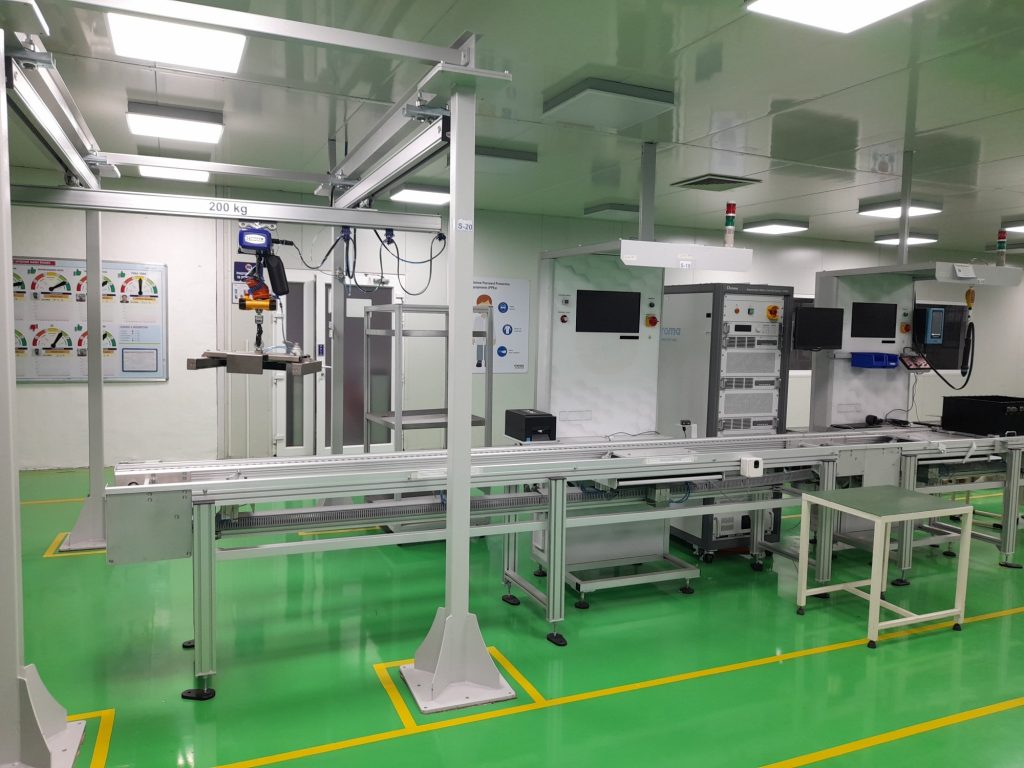
Basic Understanding of Prismatic Cell Battery Production Line
Before learning production steps, it’s essential to figure out what a prismatic cell battery production line truly is. Different from cylindrical battery production equipment, a professional prismatic cell battery production line is tailor-made for hard-shell square lithium batteries, covering front, middle and back-end full-process production.
This type of production line is divided into three types according to usage scenarios: laboratory pilot line, semi-automatic trial production line, and fully automatic mass production line. Each type matches different production demands. With more than 15 years of engineering and manufacturing experience, Xiaowei New Energy delivers a complete turnkey solution for prismatic cell battery manufacturing, including factory layout, equipment integration, and full production support.
Step-by-Step Prismatic Cell Manufacturing Process & Core Equipment
The complete prismatic cell manufacturing process is systematic and standardized. In practical manufacturing, even small variations in electrode thickness, stacking alignment or welding quality can influence battery consistency and yield rate. We can split the entire prismatic cell manufacturing process into three core stages.
Front-end Pole Piece Preparation
This is the preliminary foundation of the whole production. The main steps include slurry mixing, precise coating, calendaring and slitting. Different from ordinary battery production, the prismatic cell manufacturing process has stricter requirements on pole piece flatness and thickness. Uneven pole pieces will cause battery bulging and performance failure in subsequent stacking, so precision control is crucial here.
Middle-end Core Stacking & Forming
This is the most distinctive step of the prismatic cell manufacturing process and the core difference from cylindrical battery production. The prismatic cell battery production line is equipped with professional Z-shaped lamination stacking machines instead of winding equipment. The stacking technology makes the internal battery stress more uniform, effectively improving energy density and cycle life. After stacking, the procedures of shell loading, laser welding and sealing are completed in sequence to ensure battery airtightness and safety.
Back-end Injection, Activation & Testing
The final stage determines the finished battery qualification rate. The process includes vacuum electrolyte injection, high-temperature standing, cell formation, aging and capacity grading. This manufacturing system supports multi-dimensional precision testing, covering internal resistance detection, OCV testing, expansion rate inspection and air tightness screening. Strict testing ensures that each batch of batteries meets vehicle and energy storage industry standards.
Beginner’s Buyer Guide for Prismatic Cell Battery Production Line
For new investors and production managers, choosing a suitable prismatic cell battery production line is key to stable production. Combined with the prismatic cell manufacturing process, we summarize several simple and practical selection tips for beginners.
First, match the equipment configuration with production demands. Small-scale research and development suits semi-automatic lines, while large-scale mass production needs fully automatic lines with high-speed stacking and precision laser welding equipment. Second, focus on production standards, including dust-free production environment, stable yield rate and complete safety protection devices such as explosion-proof and constant temperature systems. Third, prioritize suppliers with complete after-sales training, which helps beginners quickly master equipment operation and process adjustment.
Frequently Asked Questions
Q1: What equipment is included in a prismatic cell battery production line?
A: A complete line usually includes electrode processing equipment, stacking machines, laser welding machines, electrolyte filling systems, formation equipment and testing machines.
Q2: What is the difference between prismatic and cylindrical battery production lines?
A: Prismatic production mainly uses stacking technology, while cylindrical batteries usually use winding processes.
Q3: How long does it take to build a prismatic battery production line?
A: The timeline depends on production capacity, automation level and factory requirements.
Q4: What factors should buyers consider before purchasing?
A: Key factors include production capacity, automation level, equipment accuracy, supplier experience and after-sales support.
Q5: Why is stacking technology important for prismatic batteries?
A: Stacking improves internal space utilization, reduces stress concentration and helps achieve better battery performance.
Final Thoughts on Prismatic Cell Production Line
A well-designed prismatic cell battery production line combines precision equipment, intelligent manufacturing systems and strict quality control processes. Understanding the complete manufacturing workflow helps investors and engineers build efficient production capabilities for future battery applications.